Electric, Tent and Primitive Sites at Arizona State Parks Compared
Choosing a campsite can feel confusing when “electric,” “tent” and “primitive” seem like competing categories. They describe different things: the services a site offers, the kind of setup it suits and how you reach it. This comparison helps you sort out those labels, match a site to your gear and check the details that can make or break a stay.
What Electric, Tent and Primitive Actually Describe
A campsite label is useful, but it is not a complete description. “Electric” tells you something about the services available. “Tent” points to the type of camping a site is meant to accommodate. “Primitive” often signals a simpler experience, but the exact access and facilities still need to be checked for the individual site.
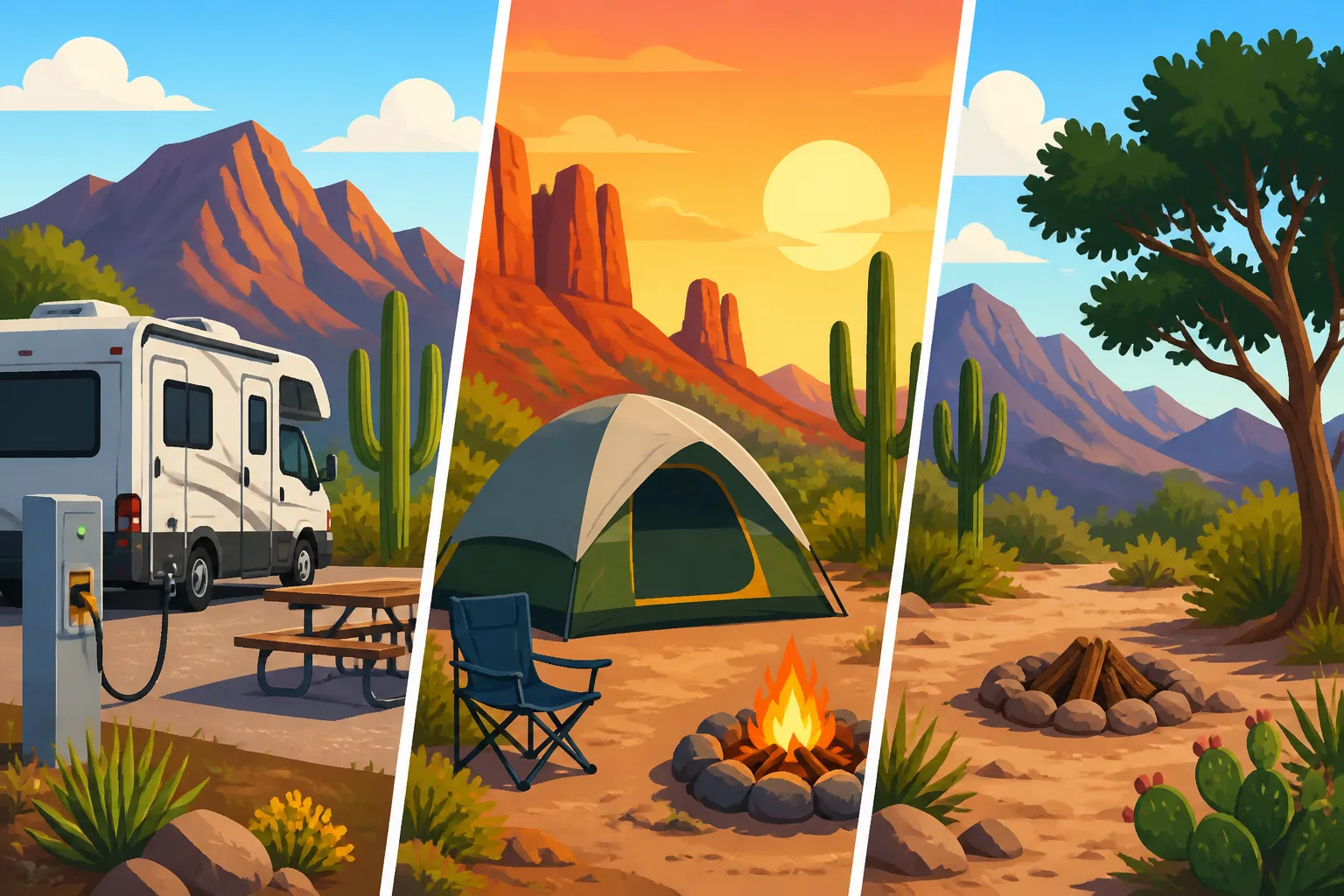
Those categories can overlap. A tent can fit at an electric site if the park allows it and the site layout works for the tent. A site described as primitive may also be tent-oriented, but the word alone does not tell you how far you will carry your gear, whether a vehicle can reach the site or what facilities are nearby. The park listing is the authority for those specifics.
Think of the labels as clues, not guarantees:
- Electric site: The listing indicates access to electrical service. Check whether water is also provided and what kind of equipment the site can accommodate.
- Tent site: The site is presented as suitable for tent camping. Confirm the surface, space, vehicle access and any site-specific limits.
- Primitive site: The listing describes a less-serviced or more basic option. Confirm the route, distance from parking, available facilities and what you need to bring.
- Non-electric site: The site does not have an electrical hookup. It may still suit a tent, RV or another setup if the park’s listing says so.
When you compare sites, separate three questions: What kind of shelter will you use? What services do you need? How much effort are you comfortable spending to reach and use the site? The answers often matter more than the label by itself.
For a broader look at camping options and how stays work, see Camping at Arizona State Parks Explained: Passes, Hookups, Stay Rules. If you are choosing specifically between a powered and unpowered site, Electric or Non-Electric Campsite? Choosing at an Arizona State Park can help you focus on that decision.
Electric Campsites: Convenience, Equipment and Trade-Offs
An electric campsite is a good fit when access to power is an important part of the trip. It may be useful for an RV that needs a compatible connection, for a camper who relies on electrical equipment or for someone who wants the convenience of charging devices at camp. But “electric” does not, by itself, tell you everything about the site.
Before selecting one, check the site’s full description. Confirm whether water is included, what electrical service is available, whether the connection matches your equipment and whether the site accommodates your vehicle or tent. If you have an RV, also check the site dimensions and approach. A hookup is only useful if your equipment can reach it and the vehicle fits safely.
Electricity can simplify a stay, but it can also make the planning more specific. You may need to know the connection type and your equipment’s requirements before you arrive. If you are bringing an extension cord or adapter, confirm that the setup is appropriate for the site and your gear. Do not assume the park provides accessories or that every powered site offers the same arrangement.
There is also a difference between having power and having every utility. A listing that mentions electric service does not necessarily promise water or sewer at the site. Look for each service separately. The distinction between a sewer hookup and a dump station is especially important for RV trips; Sewer Hookup or Dump Station? Arizona State Park RV Sites Explained can help clarify what to look for.
Electric sites are not automatically the best choice for every visitor. If your equipment does not need power, an unpowered site may be simpler. It can also be a sensible choice when you are tent camping and plan to rely on battery-powered or non-electric gear. Do not choose one only because it appears more basic or more scenic, though; confirm the location and site conditions first.
Some Arizona State Parks offer powered sites in different campground settings. Arizona State Parks & Trails says Catalina State Park has 120 campsites, with electric and water hookups. That combination may be attractive to visitors who want both services, but you should still review the individual site description and confirm whether the layout suits your equipment.
At Homolovi State Park, most sites have electric hookups and water, according to Arizona State Parks & Trails. The park also lists particular non-electric options, so read the selected site’s details rather than assuming that every campsite has the same service. Arizona State Parks & Trails identifies Sites #7, 14, 16, 35, 40, 41, 42, 44, & 46 as non-electric.
That contrast is a useful reminder: even within one campground, site features can differ. If electricity is essential, check that the specific site you plan to use is powered. If you are comfortable without a hookup, confirm that an unpowered option has the access and space you need.
Match the hookup to your trip
An electric site may make the most sense when:
- Your RV or camping equipment needs a connection.
- You want the convenience of plugging in compatible devices.
- Your trip includes equipment that you cannot reasonably run from batteries.
- You want electric service along with another listed utility, such as water.
An unpowered site may work better when:
- Your setup does not need an electrical connection.
- You are prepared to manage lighting, charging and other needs without site power.
- You are tent camping and want to avoid paying or planning for a service you will not use.
- The available non-electric site is a better fit for your preferred campground location.
For RV-specific planning, compare hookups and site fit together. A site can offer the right service but still be unsuitable for your rig because of its length, access or parking arrangement. Matching an Arizona State Park Campground to Your Rig or Tent and Confirming Water, Power and Sewer Details Before Booking an RV Site are useful next reads.
Tent Sites: Think About Fit, Surface and Setup
“Tent site” sounds straightforward, but it is not a complete checklist. The label does not tell you whether the site has a flat tent area, what the ground is like, how much usable space there is or whether you can park beside the tent. It also does not necessarily mean the site lacks electricity. Some tent campers may prefer an unpowered site; others may want power if it is available and their equipment can use it.
Start with the tent itself. Check the listed site dimensions and compare them with the tent’s footprint, including any vestibule, rainfly lines or space needed to move around it. If you are bringing multiple tents, check the park’s site-specific rules rather than assuming they will fit. A site that looks spacious in a map view may have a less practical tent area once you account for the parking space, picnic table or uneven ground.
Next, consider how you will unload. A drive-up site can be convenient because gear does not need to be carried far, but “drive-up” does not guarantee that a car can be positioned exactly beside the tent. A walk-in or hike-in arrangement changes the packing plan: you may want to consolidate gear into manageable loads and avoid bringing items that are difficult to carry. Read the description for the exact access method and check with the park if it is unclear.
River Island State Park is described by Arizona State Parks & Trails as ideal for tent campers. That description can help tent campers identify a park worth considering, but it should not replace checking the selected site’s details. A park suited to tents can still have site-to-site differences in access, space and services.
What to check before choosing a tent site
- Tent area: Look for the stated dimensions or site notes, and compare them with the tent footprint.
- Ground and slope: If the listing does not explain the surface, ask the park what to expect. A flat, stable place to sleep is more important than a site that only appears convenient on a map.
- Vehicle placement: Confirm whether the car is beside the site, in a designated space or elsewhere.
- Shade and exposure: Do not assume a tent site has shade. Review the park’s information and prepare for the conditions described.
- Nearby facilities: Check what restrooms, water sources and other facilities are available, and how you reach them.
- Power: Verify whether the site is powered if you want electricity, or non-electric if you prefer to camp without a hookup.
- Weather exposure: Consider wind, heat and rain when deciding what shelter and stakes to bring.
A tent site can suit a first-time camper, but it is still worth choosing based on the whole setup rather than the label. If you are new to camping, Camping for the First Time at an Arizona State Park: Gear Checklist can help you decide what to pack. For beach or shoreline trips, do not assume that every site is right beside the water; Lakeside Camping at Arizona State Parks: Booking Shoreline Sites explains why the exact location matters.
Primitive Campsites: A Simpler Stay That Needs More Checking
Primitive camping appeals to visitors who want a less-developed arrangement or are comfortable bringing more of what they need. The word “primitive,” however, can mean different things from one park or site to another. It does not reliably tell you whether a site is walk-in, hike-in, vehicle-accessible, close to facilities or suitable for a particular shelter. Read the listing closely and ask the park when the details are not clear.
A hike-in campsite has an added access question: how far is the walk, what is the path like and how much gear can you comfortably carry? Do not plan around a short stroll unless the park confirms the distance and conditions. Think about everyone in your group, including children and anyone who may have difficulty walking with a load. A lightweight tent and compact cooking kit may make a hike-in stay easier, but the site’s own requirements come first.
Also check what you should bring. A primitive site may require more self-sufficiency than a campground with services, but do not infer specific facilities from the label alone. Confirm whether drinking water is available, what restroom arrangements exist, whether there is a place to dispose of waste and what you should do with trash. If those details are not stated, ask before travel and plan for the possibility that you will need to carry essential supplies.
Primitive camping can be a poor fit if your group depends on frequent access to services, has heavy equipment or expects to unload directly at the sleeping area. It can be a strong fit for campers who are comfortable with the access method and have a plan for supplies, water, lighting and waste. Neither choice is automatically better; the right one is the one that meets the needs of the trip without relying on assumptions.
Arizona State Parks & Trails lists the fee for Sonoita Creek State Natural Area as Primitive hike-in site: $25 (as of November 2026). Check the park’s official information for the current fee and the details of the hike-in arrangement before planning around that cost.
Questions that matter for a primitive stay
Before choosing a primitive site, confirm:
- Whether the site is reached on foot, by vehicle or by another route.
- How far the walk is and whether the trail or route has challenging conditions.
- What facilities are available and how close they are to the site.
- Whether water is available, and whether you need to carry your own.
- What shelter is permitted or practical for the site.
- Whether cooking equipment is suitable for the park’s current rules.
- How trash and human waste must be handled.
- Whether weather or seasonal conditions could affect access.
For more background on the term, see What Does Primitive Camping Mean at an Arizona State Park?. If a hike-in site is on your shortlist, Primitive Hike-In Camping at Sonoita Creek State Natural Area may help you focus your planning on that setting.
Compare the Options Before You Choose
The best way to compare campsite types is to line up the features that affect your actual stay. Start with your shelter and vehicle, then check the services and access. A label is only useful if it answers a practical question.
| Campsite label | What it helps you identify | What it does not tell you by itself | Best next check |
|---|---|---|---|
| Electric | Whether electrical service is listed | Whether water, sewer or other utilities are included | Confirm the hookup and all listed services for the exact site |
| Tent | Whether the site is presented as suitable for tent camping | Tent-pad size, surface, shade or vehicle placement | Compare the site layout with your tent and gear |
| Primitive | That the stay may involve fewer services or a simpler setup | Access route, facility availability or how much gear to carry | Verify access, facilities, water and waste arrangements |
| Non-electric | That an electrical hookup is not listed for the site | Whether the site is suitable for an RV, tent or other setup | Check the complete site description and restrictions |
A practical comparison starts with the non-negotiables. If your RV requires power, an electric site may be necessary. If you are tent camping, a suitable tent area and straightforward access may matter more than the hookup. If you want a hike-in experience, a primitive site may work, provided you can manage the route and supplies.
Then weigh the conveniences. Electricity can reduce the need to rely on batteries, but it does not remove the need to check water, sewer or site fit. A tent site can be comfortable when its layout works, but the category does not promise shade or a level sleeping surface. A primitive site may offer a quieter or simpler-feeling stay, but the access and self-sufficiency requirements should be clear before you commit.
You can also compare the full trip rather than just the site. Consider how long you will be staying, what you plan to cook, whether anyone needs reliable charging or refrigeration, how much equipment you can carry and whether your group can manage the route to camp. If you will arrive late, verify the park’s arrival and gate details instead of assuming the campground will be accessible at any hour. Gate Codes and Late Check-Ins at Arizona State Park Campgrounds covers the questions to ask.
A quick decision path
Use these questions in order:
- Does your equipment need power? If yes, look for an electric site and confirm the connection details. If not, compare powered and non-powered sites on layout, location and price information shown by the park.
- Are you sleeping in a tent? Check whether the site is suitable for your tent size and how you will position the car and gear.
- Will you carry supplies to the site? If so, confirm the access route and the distance before packing.
- Do you need water, restrooms or other services nearby? Verify each one separately rather than treating the campsite label as a promise.
- Does your vehicle fit? Review dimensions, parking and access details if bringing an RV, trailer or multiple vehicles.
- Can your group handle the conditions? Account for heat, cold, wind, physical access and the amount of work involved in camp setup.
When a listing does not answer one of those questions, treat it as unresolved. Contact the park through its official website before relying on an assumption.
How to Read a Site Listing and Avoid Mismatches
A site listing is more than a place to choose a date. It is where you verify whether the campsite matches the gear and expectations you bring. Read the overall campground information, then the individual site details. One may describe shared facilities while the other explains the specific site’s services or dimensions.
Pay close attention to words that sound similar but mean different things. “Electric” and “water” are separate services. “Tent” does not necessarily mean “no hookups.” “Primitive” does not provide a precise account of access or facilities. “Non-electric” tells you about power, not necessarily about the site’s suitability for a tent or RV.
Look for the site map and written description together. A map can show relative position, but it may not give enough information about slope, surface or the distance to facilities. Written descriptions can explain the site type, but they may not reveal how your equipment will fit. Comparing both sources gives you a more useful picture.
If you are bringing an RV or trailer, check the length and configuration the site can handle. Consider the full combination, including anything you tow, as well as the space required to park and set up. Do not rely on a campground-wide statement if the specific site has its own restrictions. Will Your Gear Fit? Comparing Site Sizes Across Arizona State Parks is useful for thinking through site fit.
For tent camping, check the dimensions and the location of the tent area. A site may be listed for tents but still require careful placement around a parking space, table or other fixed features. If the map does not show the tent area clearly, ask whether the park can describe the surface and layout.
For primitive sites, confirm the route and facilities before considering the packing list complete. Ask what you need to carry in and whether there are particular arrangements for water, restrooms or waste. A backpacking-style setup may be a better match than bulky camp furniture if the route is on foot, but verify the actual access rather than deciding based on the word “primitive.”
Check current conditions and rules separately
A campsite description may not answer questions about temporary changes. Before leaving, check the official park information for current road access, closures, services and any rules that affect your equipment or plans. Conditions can change, and a site that is usually available may be affected by maintenance or weather.
Fire rules need a separate check. Do not assume a fire ring means a fire is allowed, and do not rely on old information or a previous visit. Check the relevant official information before you leave and again when you arrive. If the park’s own rules are unclear, ask the park rather than guessing.
Also confirm arrival requirements, check-in procedures and any instructions for late arrival with the official reservation information. If you are comparing campsite and cabin options, Camping at Arizona State Parks Explained: Passes, Hookups, Stay Rules offers a broader overview of what to consider across an overnight trip.
Match the Campsite to Your Camping Style
A useful campsite choice reflects how you actually camp, not how you wish you camped. If you tend to bring a large setup, choose a site based on the gear’s real footprint. If you prefer minimal packing, a primitive option may be appealing, but only when the route and available facilities suit your group. If you rely on power, do not book an unpowered site and hope to improvise.
For an RV or trailer
Start with the vehicle, not the hookup. Check the site’s length, access, parking arrangement and approach. Then confirm the exact electrical service and whether water or sewer is available at the site or elsewhere in the campground. A site described as electric does not necessarily include every utility an RV might use.
Plan for the arrival and setup too. A tight turn or difficult backing arrangement can matter as much as the service connection. If you have a trailer, account for the tow vehicle and how both will fit. Verify that the site is compatible with your setup before choosing it.
If you want to camp without hookups, check that the campground permits your intended arrangement and that you can manage water, power and waste for the trip. Hookup or No Hookup? Dry Camping an RV at Arizona State Parks can help you consider the trade-offs.
For a tent camper
Decide whether you need electricity before filtering your options. Some tent campers value power for charging or other compatible equipment; others prefer a simpler, unpowered site. Either can work if the park allows the setup and the site fits the tent.
Choose based on the tent footprint, parking and access. If the site is walk-in, pack with the carry in mind. If it is drive-up, check how close the vehicle can get and where the tent goes. Bring appropriate stakes and shelter for the conditions the park describes, rather than assuming the site will provide shade or protection.
For a hike-in camper
Consider the journey to the campsite as part of the campsite itself. The distance and terrain affect what you can bring, how much water and food you need to carry and how the group will manage arrival. Confirm the route and site conditions with the park before you select your gear.
Keep the packing plan focused. Heavy furniture and bulky extras can turn an easy walk into a difficult load. At the same time, do not underpack essentials because you expect facilities that the park has not confirmed. Ask about water, restrooms, waste and cooking arrangements, then plan accordingly.
For a mixed group
Different campers in one group may need different things. One person may want a powered RV site, while another prefers a tent or a more basic arrangement. Before booking, decide whether the group can stay together at one site or needs separate sites. Confirm any rules on occupancy, vehicles and equipment directly with the park.
Do not assume a larger site will solve every mismatch. A site may have enough room for people but not for several shelters and vehicles. If separate reservations are needed, check whether the sites are close enough for the group’s plans and whether each one has the right services. Booking Several Arizona State Park Campsites for One Group Trip can help with the coordination questions.
Plan the Stay Around the Site You Select
Once you have chosen a campsite type, build the rest of your plan around that specific site. Recheck the listing close to travel, verify arrival instructions and make sure everyone knows what services are available. The site category is only the beginning; the details determine what you need to bring.
For an electric site, bring equipment that matches the listed service and plan a backup for essential devices if appropriate. Do not assume the site includes water or sewer unless those services are listed. If a connection is essential, confirm it before arrival rather than relying on a broad campground description.
For a tent site, test your layout before the trip if you can. Know where the tent poles, stakes, rainfly and sleeping gear go, and consider how you will keep equipment organized if the weather changes. A compact plan helps when the site is smaller or more exposed than expected.
For a primitive site, treat access and supplies as central parts of the itinerary. Pack in a way that is manageable on the route, and confirm what facilities exist. If there is no confirmed water source, plan with the park’s guidance rather than making assumptions. Consider what you will do with food, trash and used cooking materials before you set out.
Weather preparation matters across all three categories. A powered site does not protect a tent from heat or wind. A tent site does not guarantee shade. A primitive site may make it harder to reach the vehicle or facilities. Check conditions and pack for the park’s setting, including the possibility that conditions differ between day and night.
Finally, keep a backup plan for a mismatch. If you arrive and discover that the site does not suit your equipment, contact park staff through the available official channels. Do not move into another campsite or alter the site arrangement without confirming that it is allowed. A little research before arrival is much easier than trying to solve an equipment problem after setup.
Frequently Asked Questions
Is an electric site only for RVs?
No. The label identifies electrical service, not necessarily a vehicle type. Check the site listing to confirm whether tents are allowed and whether the layout works for your setup.
Does a tent site have to be non-electric?
No. “Tent” describes the intended shelter, while “electric” describes a service. Check the individual listing to see whether both apply to the site you are considering.
Does primitive mean there are no facilities?
Not necessarily. The word alone does not establish which facilities are available. Confirm water, restrooms, waste arrangements and access with the park before you go.
What should I do if a campsite listing does not explain a detail I need?
Treat it as unconfirmed and ask the park through its official website. This is especially important for access, hookups, site dimensions and facilities that affect your equipment or group.
Sources
- Arizona State Parks & Trails — Catalina State Park | Arizona (checked November 22, 2026)
- Arizona State Parks & Trails — RV and Tent Camping | Homolovi State Park (checked November 23, 2026)
- Arizona State Parks & Trails — Sonoita Creek State Natural Area | Arizona (checked November 23, 2026)
- Arizona State Parks & Trails — River Island State Park | Arizona (checked November 23, 2026)
Disclaimer
This article is for general informational purposes only and does not constitute professional advice. Laws, prices and regulations vary by location and change over time. Consult a qualified professional for guidance on your specific situation. Arizona Camping & RV is not a government agency and is not affiliated with any government agency.